
David's Blog

Living a quiet life in Coquitlam, B.C.

Name:
Location: Coquitlam, British Columbia, Canada

Monday, January 11, 2016

Parabola by Conical Section

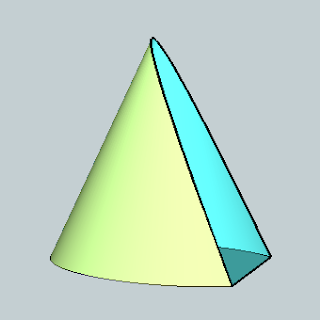
A parabola is created when a diagonal cutting plane passes through a right cone at an angle parallel to a side of the cone.

claimtoken-569d57382f524


(In the images, imagine the cone extends downward to infinity, so the parabolic section created also goes to infinity.)


The height-to-base radius ratio of the cone is given by γ:


The angle of a side of the cone is, therefore, α   =   arctan(γ) with respect to the horizontal. To make a parabolic section, a cutting plane must pass through the cone at the same angle, α, with respect to the horizontal. Say this cutting plane is made such that it intersects the axis of the cone at a vertical distance hc from the tip of the cone.


rc is the radius of the cone where the cutting plane intersects the axis of the cone (= hc/γ).

ru is the distance from the cone axis to the upper edge of the cone, measured along the cutting plane.

In addition, an x-y-z coordinate system is affixed to the cutting plane.
(0, 0, 0) is on the cutting plane where it intersects the surface of the cone on the upper side.
Positive x is on the cutting plane, going through the cone axis and aligned with the long side of the cut.
Δ x = x - ru
Positive y is on the cutting plane, going up.
Positive z is perpendicular to the cutting plane.

Looking at the section from above, and perpendicular to, the plane of the cut, it appears as illustrated in the following image (note positive z comes out of the page toward at the viewer):


On the plane of the parabolic section, the distance from the cone axis to the upper edge of the cone is given by the same expression as for an elliptical section:


In fact, because the cutting plane is parallel to an edge of the cone when creating a parabola, the expression can be simplified somewhat:


or
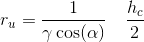


or


The orientation of this example's geometry means the resulting parabola should take the following form:


One point on the parabola is already known, which can be used to solve for c:

ru = (1/(4c))   (rc)2

Solving for c:


or via the other two expressions for ru.

(Doing a quick comparison of ru and c, we see that ru is larger than c for most values of γ.)

At this point, we think and hope a parabolic section has been created. After all, that is what theory says, doesn't it? But let's confirm that theory for ourselves, and continue to work through an analysis of the physical model. We can confirm that a parabolic section is, indeed, produced by calculating coordinates along the cone/cutting plane intersection.

Each value of Δ x corresponds to a vertical displacement down the cone axis of (Δ x) (sin(α)) and at this point
h = hc + (Δ x) (sin(α))

The radius of the cone at this point is
r = [hc + (Δ x) (sin(α))] / γ

Looking at a circular cross-section of the cone at this point, the displacement perpendicular to the cone axis is (Δ x) (cos(α)). In the circular cross-section, this corresponds to an angle of
τ = arccos{[(Δ x) (cos(α))] / [r] }

The y-coordinate along the edge of the cone is then found as y = r sin(τ).


or


Now let's create a numeric example and generate some data.

Say γ = 1.27201964951 and hc = 100.
α = arctan(γ) = 0.904556894301 rad
ru = 63.6009824759
c = 24.2934135879

Tabulating values for x = 0 to x = 100, we get the following data.

x     y
0     0
10     31.1726890644
20     44.0848396506
30     53.9926812684
40     62.3453781291
50     69.7042517899
60     76.3571821187
63.6009824     78.615137776
70     82.4751829621
80     88.1696793012
90     93.5180671937
100     98.5766982364


These data points represent a parabolic curve with the c value stated above. Furthermore, these points are verified by the standard form for a parabola for the given value of c:     x   =   (1/(4c))   y2

In other words, analysis of the physical model underlying a parabolic curve confirms the theory.  
 

Labels: , ,

Friday, April 26, 2013

Conical Sections: A Deeper Look Part 2

This post continues from the previous post.
The previous post presented some very fundamental features of a cone and the ellipse that is created by a cutting plane going through it at an angle. I would now like to pick a particular cone and cutting angle to use for a numerical example. At this point, any cone-angle combination is equally suitable. However, perhaps by examining some other features of a conic section, a particular section will suggest itself for use as a numerical example.

Some conditions:

First, the cutting angle, α, must satisfy the following condition: 0 < α < arctan(γ).
If the angle is too big or too small, the resulting section will not be an ellipse; it will be a circle, parabola, or hyperbola.

Second, at the bottom of the previous post, I determined that the value of α for which ru is a minimum is α = arctan(1/γ).
So, I will restrict my examination to right cones for which γ > 1.

Third, because I am hoping this exploration will reveal some information that may provide further insight applicable to elliptical motion, I am going to impose one more condition:
a circular section going through the same right cone, of equal area of the ellipse, must be at the same height on the cone as the mid-point of the ellipse.
Area of a circle: π r ²
Area of an ellipse: π ab
Therefore, hqa = γ √(ab) = hc + ro sin(α)
After some algebraic manipulation, this reduces to
cos(α) = (1 - e²)(1/4)
Which, in turn, leads to cos(α) = (1/γ).

So now a condition exists to define a particular class of elliptical section, which I am calling a qa-section (an elliptical section produced such that its equal-area circle is at the mid-point of the ellipse). Following are some properties of these qa-sections (including parameters from my previous post which can be simplified under these conditions).

Summary of Features for a qa Elliptical Section


However, even after applying these restrictions, an infinite number of sections is still possible. Perhaps a graph will illuminate some feature I can use. On the following image are two graphs: αqa and αrumin versus γ.
αqa (the red line) is α for a qa-section (= arccos(1/γ)).
αrumin (the blue line) is the value of α for which ru is a minimum.


These lines intersect at only one point; this point suggests the cone-cutting plane I will use for numerical examples.
In fact, this point of intersection occurs when arccos(1/γ) = arctan(1/γ)
γ is then found as the solution to the following equation: γ 4 - γ ² - 1 = 0
This equation has four solutions:


These solutions correspond to γ = +/- 1.272019649514069 and +/- 0.786151377757i.

The imaginary roots and the negative real root are meaningless in the present context; only the real, positive, solution is applicable:
γ = 1.272019649514069

Alternately, these roots could have been found by forming the Companion Matrix for this polynomial and computing its eigenvalues and eigenvectors. The eigenvalues are the roots of the original polynomial. The Companion Matrix is


Two eigenvalues are +/- 0.7861513777574233i, and the associated eigenvectors are


The other two eigenvalues are +/- 1.272019649514069, and the associated eigenvectors are


So the roots have been confirmed.
This cone (γ = 1.272019649514069), and all the properties that follow from it, will be used for numerical examples going forward.

Some Numbers for the qa Elliptical Section for γ = 1.272019649514069

(a = 1)

γ = 1.272019649514069
α = 0.666239432488 radians
e = 0.786151377754
ru = 0.381966011254
rl = 1.61803398875
ro = 0.618033988738
rc = 0.485868271774
hc = 0.618033988764
b = 0.618033988764
hqa = 1
rqa = 0.786151377767
cos(α) = 0.78615137776
sin(α) = 0.618033988746 = cos²(α)
tan(α) = 0.78615137776

Note that the expression under the radical returns itself:
0.618033988738 = √(1 - √ (1 - e²))
0.618033988738 = √(1 - √(1 - √ (1 - e²)))
etc.
This could go on forever.
In other words, this number satisfies the infinite expression
x = √(1 - √ (1 - √ (1 - √ (...))))


Before closing this post, I would like to point out that simply projecting a circle onto a plane inclined at an angle of 0.666239432488 radians would not produce an ellipse of eccentricity e = 0.786151377754. In fact, you would produce an ellipse, but not one of this eccentricity.
To confirm this assertion, y-coordinates of a circle have been multiplied by cos(α) and tabulated in a table in a previous post (Blog Post: Ellipse Sample Datapoints), under the column labeled ycon. Note that the values tabulated in this column do not product an ellipse of eccentricity 0.786151377754. In fact, an ellipse of eccentricity 0.618033988747 is produced. To produce an ellipse of the same eccentricity as the one produced by the conic section--and a cutting plane of the same angle, α--the ycon values have to be multiplied by an additional factor of cos(α).
 

Labels: , ,

Sunday, April 07, 2013

Conical Sections: A Deeper Look Part 1

This post goes into more details about elliptical sections that are created by taking an inclined cutting plane through a right cone. This topic was briefly investigated in a previous post, Blog Post: Ellipse by Conical Section; here I investigate more deeply the details of ellipses by conical sections.

A 3D image of a cone and cutting plane are presented in the post mentioned above. Just below is an image of a side view of the cut going through the cone:


In this image, several variables are measured with respect to the axis of the cone.
H is the overall height of the cone.
R is the radius of the bottom of the cone.
These two characteristics of the cone are used to define another parameter, the height-to-radius ratio: γ = H/B

α is the angle at which the cutting plane goes through the cone, with respect to the horizontal.

hc is the vertical distance from the tip of the cone to the point where the cutting plane intersects the axis of the cone.
rc is the radius of the cone where the cutting plane intersects the axis of the cone (= hc/γ).

ru is the distance from the cone axis to the upper edge of the cone, measured along the inclined plane.
rl is the distance from the cone axis to the lower edge of the cone, measured along the inclined plane.

Looking more closely at one half of the cross-section, a few more properties of the section can be introduced, as illustrated in the following image:


ro is the distance from the cone axis to the center of the ellipse, measured along the elliptical plane.
hqa is the vertical distance from the tip of the cone to the horizontal plane on which lies the center of the ellipse.
rqa is the horizontal distance from the cone axis to the center of the ellipse.

At this point, enough parameters have been introduced. Now it is time to start defining them.


or


or


a, the length of the semi-major axis of the ellipse, can be found as follows:
ru + rl = 2a

Therefore,


b, the length of the semi-minor axis of the ellipse, is


Some generic relationships between the basic parameters of the cone and the cutting plane can also be defined:


Just out of curiousity, I would like to confirm the value of α for which ru is a minimum. Differentiating the expression for ru above with respect to α, and setting the resulting equation equal to 0, we find that ru is a minimum when α = arctan(1/γ) = π/2 - arctan(γ).
In other words, ru is a minimum when the cutting plane goes through the cone at an angle that is perpendicular to the side of the cone.
A similar examination using rl leads to the same requirement.


Labels: , ,

Sunday, November 25, 2012

Ellipse by Conical Section

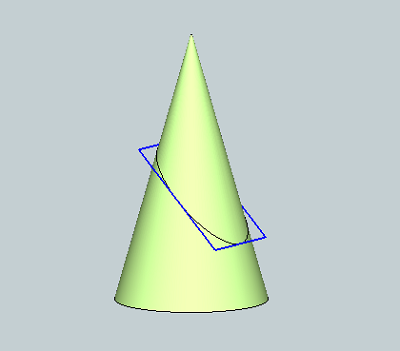
This post examines elliptical sections which are created by taking a diagonal cutting plane through a right cone.


When the cutting plane goes through the cone at an angle, the surface created takes the form of an ellipse:


To verify this statement, let's look at the cone from the side and affix the origin of an x-y-z coordinate system to the center line of the cone. Positive x is on the cutting plane, aligned with the long side of the cut. Positive y is on the cutting plane, aligned with the short side of the cut and going into the page. Positive z is perpendicular to the cutting plane.   α is the angle at which the cutting plane cut through the cone, with respect to the horizontal. See the following image for an illustration of these properties.


Looking at the section from above, and perpendicular to, the plane of the section, it appears as illustrated in the following image (the z-axis is coming out of the page, straight at the viewer):


One feature of this section should be noted: the center of the ellipse does not coincide with the center line of the cone that produced it. The center line of the cone intersects the elliptical plane at the origin of the X-Y-Z coordinate system. HOWEVER, the center of the ellipse is at the origin of the Xe-Ye-Ze coordinate system, which is offset by an amount ro from the origin of the X-Y-Z system in the positive X direction (see the image above).

Numbers will now be assigned to the section, and some numerical results calculated, to confirm that an ellipse is, indeed, described.

Values for a and e will be the same as were used in the previous post (for a section created through a cylinder):

a = 1
e = 0.786151377746

An infinite number of cone and cutting plane combinations could produce an ellipse with this eccentricity, so one more constraining parameter, gamma, will be defined:

γ = h/r

where h is the height of the cone, and
r is the radius of the bottom of the cone.

γ now serves as a parameter to define a cone uniquely by its height/radius ratio. Then

α =   arcsin[(γ e)/√(γ² + 1)]   and

ro =   a   (tan(α)/γ)

For the purpose of the following numerical example, γ = 1.27201964953.
The necessary cutting plane is then α = 0.666239432494 radians, and
ro = 0.618033988735.

To summarize:

γ = 1.27201964953
α = 0.666239432494 radians
e = 0.786151377746
a = 1
ro = 0.618033988735
b = √(1 - e²) = 0.618033988764

(Note that the angle of the cutting plane, α, is much smaller in this case than it was when a section was taken through a cylinder--to produce an ellipse of the same eccentricity.)

Now to compute some data points. Keep in mind that xe and ye are in the plane of the ellipse.

Start with a value of xe in the Xe-Ye plane.
Calculate the ye value at this xe point.

Projecting xe into the horizontal plane and measuring with respect to the cone axis,

x = (ro + xe) cos(α)

The radius of the cone at this level is

r = (γ cos(α) + sin(α) xe)/γ

On a circle in the horizontal plane, this x value corresponds to an angle of

θ = arccos(x/r)

In turn, this angle corresponds to a ye value:

ye = r sin(θ)

As a quick check, at xe = 0,

r = cos(α) = 0.786151377757
θ = arccos(tan(α)/γ) = arccos(0.618033988754) = 0.904556894297

Then ye = r sin(θ) = 0.786151377757*sin(0.904556894297) = 0.618033988738

Remember that this value of ye corresponds to b, the mid-point of the ellipse. And because this value is the same as the one calculated from the standard equation for an ellipse, b = √(1 - e²), this is a good indication that the section is an ellipse.

An alternative to this rather roundabout way is to use the following equation for ye:


Whichever technique is used, computing some values for ye,
for xe = 0.05, ye = 0.617260962835
for xe = 0.10, ye = 0.614936054525
and so on.

Values for a quarter-section of the ellipse are tabulated in another blog post:

Blog Post: Ellipse Sample Datapoints
Datapoints computed from the expression for ye above are tabulated in the column under the heading ye. Note that these values are the same as the values computed from the standard equation of an ellipse.

Apparently, taking a diagonal cutting plane through a right cone does, indeed, produce an ellipse.


Labels: , ,
